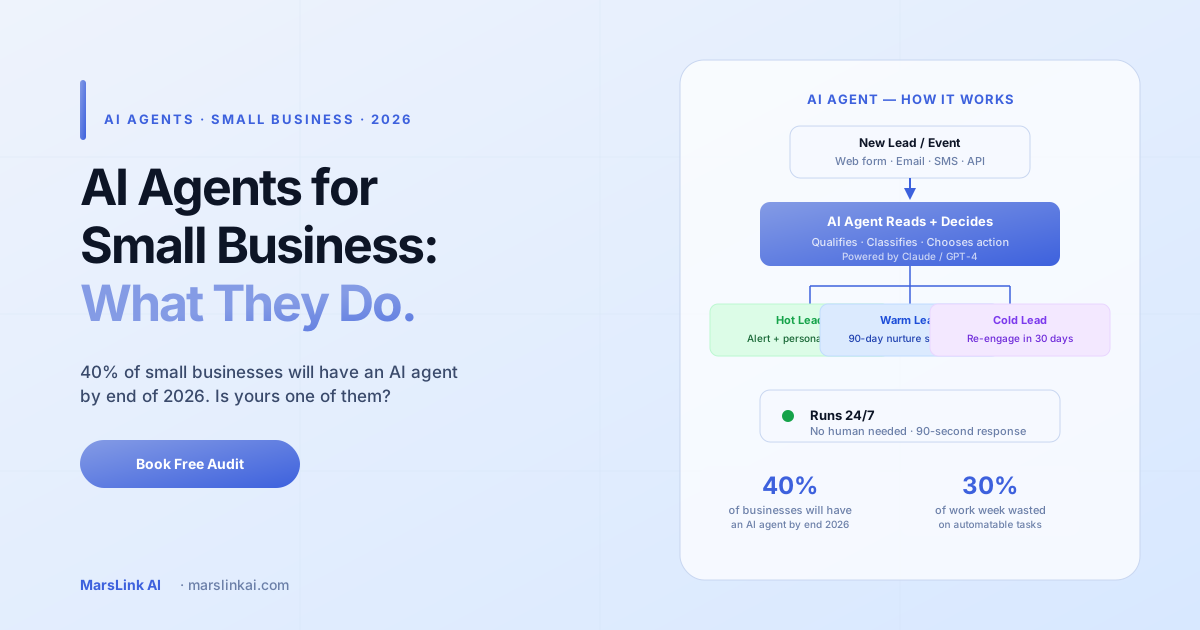
40% of small businesses will have an AI agent running by end of 2026. That's not a tech prediction, it's already happening. The businesses adopting early are pulling away from competitors who are still doing things manually. The gap will be hard to close in 2027.
But most of what's written about AI agents is either too vague ("it will transform your business!") or too technical (embeddings, vector stores, LLM orchestration). This guide skips both. Plain English, real examples, real numbers.
What Is an AI Agent, Actually?
A traditional automation does the same thing every time: if A happens, do B. Simple, fast, reliable, but it can't handle variation. If something unexpected comes in, it breaks or skips it.
An AI agent can read, understand, decide, and act. It looks at what came in, figures out what it means, decides what to do, and does it. Then it reports back.
Example: A traditional automation might send a confirmation email when a form is submitted. An AI agent reads that form, understands whether the person is a hot lead or a tire-kicker, writes a personalized response based on what they said, adds them to the right follow-up sequence, notifies your team if they're urgent, and logs everything, without any rules hardcoded for each possible scenario.
That's the difference. Automation follows rules. AI agents follow intent.
What AI Agents Can Actually Do for Your Business
Stop thinking about AI agents as a technology and start thinking about them as a role. The question isn't "how does it work?", it's "what job does it do?"
The Lead Response Agent
Reads every incoming lead, qualifies them, writes a personalized first reply, routes them to the right sequence, and notifies you when someone is urgent. Runs 24/7 including nights and weekends. Response time: under 90 seconds, every time. This is the highest-ROI agent for most service businesses.
The Outreach Agent
Finds leads matching your criteria, researches each company or person, writes a personalized cold email or DM, sends it on schedule, manages follow-up, and notifies you when someone replies. Scale from 30 contacts/day to 400/day without adding a single person to your team.
The Market Intelligence Agent
Monitors your market for signals, competitor pricing changes, new listings, industry news, social media mentions, and alerts you the moment something relevant happens. The agent that watches for price drops and sends a Telegram alert in 90 seconds is a market intelligence agent.
The Content Agent
Ingests sources (RSS feeds, Reddit, newsletters, YouTube), scores content by relevance and virality, writes summaries or full posts, and publishes them on schedule. Powers our own The AI Brief newsletter pipeline, 500+ sources ingested daily, 30–70 posts published automatically, zero manual curation.
The Operations Agent
Handles admin tasks that eat your team's time: generating reports, updating CRM records, processing invoices, sending reminders, managing intake forms. It's the invisible employee that does all the copy-paste work your highest-paid people currently spend 30% of their week on.
AI Agent vs. Chatbot vs. Automation, What's the Difference?
| Type | What It Does | Best For | Limitation |
|---|---|---|---|
| Basic Automation (Zapier, Make) |
If A do B. Always the same response. | Simple, repetitive triggers with no variation | Can't handle new situations. Breaks on edge cases. |
| Chatbot | Answers predefined FAQs on your website or messaging app. | Basic customer support, FAQ deflection | Scripted. Frustrating when questions don't match the script. |
| AI Agent | Reads context, decides, acts, reports back. Handles variation. | Lead response, outreach, monitoring, operations | Higher build complexity. Needs proper scoping to avoid hallucinations. |
Most businesses don't need all three. They need one well-built AI agent solving their highest-cost problem. That's it. Start there.
Which Businesses Benefit Most in 2026
AI agents pay off fastest when the business has high lead volume, high transaction value, or high labor cost in a repetitive area. The best fits:
- Real estate agents and teams, high transaction value, speed-to-lead is the #1 competitive factor
- Medspas and healthcare practices, high no-show cost, high patient LTV, compliance-heavy intake that eats admin time
- Marketing agencies, repetitive reporting, outreach at scale, content pipelines
- E-commerce brands ($1M+), cart abandonment, post-purchase sequences, customer service volume
- B2B service businesses, proposal generation, lead qualification, follow-up sequences
Businesses that don't benefit yet: very early stage (under $200K revenue, still figuring out the business model), businesses with fewer than 10 leads/month, or anyone who hasn't yet standardized their process. Automate what works. Don't automate chaos.
The 5 Business Problems AI Agents Solve in 2026
1. Lead response speed. 78% of customers buy from the first responder. If you're not first, you're usually not in the deal. An AI agent makes you first, every time, even at 2am on a Sunday.
2. Follow-up consistency. Most business owners have a graveyard of leads who said "reach out in 3 months" and never heard from them again. An AI nurture agent follows up every time, every lead, on schedule, forever.
3. Outreach scale. If you're limited to 30 cold contacts per day by human capacity, an outreach agent doesn't get tired. 300 contacts a day, each with a personalized opener, managed follow-up, and reply detection. Same quality. 10x volume.
4. Market intelligence. Your competitors can't watch 500 listings, 10 competitor pricing pages, and 3 industry news feeds simultaneously. Your AI agent can. You move first because you see it first.
5. Operations overhead. Every hour your team spends updating spreadsheets, building reports, and sending reminders is an hour not spent on revenue-generating work. AI operations agents eliminate the overhead invisibly.
How to Get Started Without Wasting Money
The biggest mistake businesses make with AI agents: starting too big. They try to automate everything at once, the project balloons in scope, it takes 3 months, and by the time it launches, half of it is already outdated.
The right approach:
- Identify your one highest-cost manual process. Not the most interesting one. The one that costs you the most money or time right now. That's your starting point.
- Define the exact deliverable. What does "done" look like? A lead response agent is done when every new lead gets a personalized response in under 90 seconds. That's a specific, measurable outcome.
- Build one agent. Run it. Measure the result. Four weeks of live data will tell you more than any planning session. Then build the second one.
- Own your stack. Build on infrastructure you control, not a proprietary SaaS that charges per-action and holds your data hostage. When you need to change something, you should own the code.
Not Sure Which AI Agent Your Business Needs First?
That's exactly what our AI Workflow Audit answers. 30 minutes: we map your workflow, find where you're losing the most money to manual work, and tell you which agent to build first, and what it's worth to build it. Free, no obligation.
Book Your Free 30-Min AuditThe Real Question
Forget "should I get an AI agent." That's the wrong question.
The right question is: what is it costing me every month to NOT have one?
If your lead response time is 47 hours, calculate what a 21x improvement in conversion rate would mean for your revenue. If your team spends 15 hours/week on manual tasks, calculate the dollar value of that time. If you're losing 15% of appointments to no-shows, calculate what that costs annually.
Usually, the cost of inaction is far larger than the cost of building the agent. And unlike a hire, which comes with a salary, benefits, management overhead, and the possibility of leaving, an AI agent runs 24/7, never gets sick, and costs a flat one-time build fee.
The businesses winning in 2026 aren't more talented. They have better leverage. AI agents are leverage.